
Thread Lift in Myeongdong, Seoul
Quick answer: A thread lift uses dissolvable PDO threads placed under the skin to reposition sagging cheeks and jowls and stimulate collagen, without surgery. At Dernia Clinic Myeongdong it starts from ₩690,000 per area (KRW, VAT excluded), depending on thread count. The procedure takes 30–60 minutes, swelling or bruising lasts 3–7 days, and results commonly last about 12–18 months.
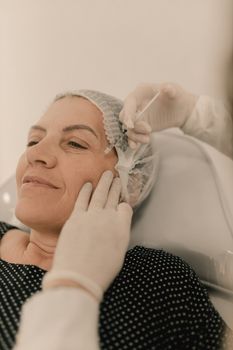
- Price from: ₩690,000 (per area; thread count varies)
- Procedure time: 30–60 minutes under local anesthetic
- Material: Dissolvable PDO (polydioxanone) threads
- Downtime: 3–7 days of swelling or bruising
- Results: Immediate repositioning, settling over 2–4 weeks
- Longevity: About 12–18 months
- Best for: Moderate jowls, sagging cheeks, deepening smile lines
What is a thread lift?
A thread lift is a minimally invasive procedure in which fine, dissolvable threads are placed under the skin to lift and support sagging tissue. At Dernia we use PDO (polydioxanone) threads, a material long used in dissolvable surgical sutures. Some threads have tiny barbs or cogs that grip the tissue so it can be repositioned. Others are smooth and mainly stimulate collagen.
A thread lift sits between energy-based lifting and surgery. It gives a more visible, immediate lift than devices, with a few days of recovery rather than weeks. It is one of the stronger options in our lifting treatment menu.
How a thread lift works
- Mechanical lift: barbed threads are placed in the layer beneath the skin and drawn upward, lifting the cheeks and jowls.
- Collagen stimulation: the body forms new collagen around each thread, which helps support the tissue.
- Gradual absorption: PDO dissolves over several months, while the collagen it stimulated helps maintain the effect.
Who is a good candidate?
- Adults, typically 35 to 55, with moderate sagging of the cheeks or jowls
- Deepening nasolabial folds or marionette lines caused by descent of the mid-face
- People who want more lift than devices give but are not ready for surgery
Threads are not ideal for very thin skin with little support, or for heavy, advanced sagging where surgery gives a better result. If the main problem is lost volume rather than descent, dermal filler may be more effective. Your doctor will be candid about this.
Areas and thread plans
| Area | Typical goal | Notes |
|---|---|---|
| Jawline and jowls | Sharper jaw, less jowling | The most common single area |
| Mid-cheek | Lift the cheek, soften smile lines | Often combined with the jawline |
| Full lower face | Overall lift and contour | More threads, more swelling |
Thread count depends on your anatomy and goal. See the thread lift price page for plans. Prices are in Korean won (KRW), exclude 10% VAT, and are confirmed at your consultation.
Your procedure at Dernia, step by step
- Consultation in English with a licensed medical doctor, who assesses sagging, skin thickness and symmetry and plans vectors.
- Marking of entry points and lift directions while you sit upright.
- Local anesthetic at the entry points; you stay awake throughout.
- Thread placement through a fine cannula or needle, then gentle repositioning and checking symmetry.
- Review and a written aftercare sheet.
Downtime and aftercare
Expect swelling, bruising and a tight feeling for three to seven days. Small dimples or puckering near entry points are common early and usually settle within a couple of weeks. For about two weeks, avoid wide mouth opening, dental work, facial massage, saunas and strenuous exercise, and sleep on your back. Energy-based lifting on the same area is usually postponed for several weeks. Read normal side effects and when to contact us; contact us promptly about increasing pain, heat or a thread end poking through.
Results: what to expect and when
The lift is visible straight away but can look slightly overcorrected at first. It settles over two to four weeks as swelling fades and the tissue relaxes into place, while collagen builds for a few months. Results commonly last about 12–18 months, varying with age and skin quality. See the thread lift results timeline.
Thread lift vs other lifting treatments
Ultrasound lifting such as Ulthera Prime has no recovery but gives a subtler, gradual lift. Threads give a stronger, immediate change with a few days of swelling. Many plans combine both, with the device first. Read thread lift vs Ulthera Prime.
Planning a thread lift around a trip to Seoul
Schedule it early in your stay, ideally at least five to seven days before you fly, so swelling can settle and your doctor can check you at a follow-up. Avoid planning photos or events in the first week. Our guide to planning treatments around your itinerary helps. Book a consultation first so your doctor can confirm you are a good candidate.
Safety: who should avoid or delay it
Like any procedure, threads carry risks: asymmetry, persistent dimpling, a thread that can be felt or works its way out, infection and, rarely, nerve irritation. Careful planning, sterile technique and following aftercare reduce these, and most issues can be corrected if they occur.
A thread lift is not suitable during pregnancy or breastfeeding, with active skin infection, or with uncontrolled medical conditions. Tell your doctor about bleeding disorders, blood thinners, autoimmune disease, a history of keloids, and recent filler or threads. At Dernia, thread lifts are performed by licensed medical doctors.
Not sure which treatment is right for you?
Tell us your concerns and your travel dates. A doctor examines your skin in person, explains your options in English, and confirms the plan and price before anything is done.
FAQ
Frequently asked questions
Straight answers from our medical team. Still unsure? Ask a doctor or browse all patient questions .
Does a thread lift hurt?
Local anesthetic numbs the entry points, so most people feel pressure and tugging rather than sharp pain. The face can feel sore and tight for several days afterward.
How long does swelling last after a thread lift?
Most swelling and bruising settles within three to seven days. Mild tightness or small dimples can take up to two weeks to resolve fully.
When can I fly after a thread lift?
Flying is usually possible after a few days, but we suggest allowing five to seven days before departure so your doctor can review you and swelling can settle.
Do the threads stay in my face forever?
No. PDO threads dissolve gradually over several months. The collagen they stimulate helps the result last about 12–18 months for many people.
Can I combine threads with Ulthera or filler?
Yes, often. Energy devices are usually done first or several weeks later, and filler can restore volume that threads cannot. Your doctor will plan the order.
Keep exploring
Related treatments, prices and guides
Related treatments
- Ulthera Prime — no-downtime ultrasound lifting
- Thermage FLX — RF skin tightening
- Dermal filler — restores volume threads cannot add
Price, results and reviews
- Thread lift price in Seoul — per-area plans
- Thread lift results timeline — what to expect
- Thread lift review: is it worth it? — our medical team's view
Concerns it treats
- Jowls — lift the lower face
- Sagging skin — compare all options
Areas and guides
- Cheek treatments — lift and volume options
- Who should avoid or delay lifting treatments — safety first
Plan your visit to Dernia Clinic Myeongdong
English consultations, clear prices in Korean won and treatment plans built around your time in Seoul. Tell us your dates and we will suggest a schedule that fits.
Individual results vary. Suitability, dosage and final price are confirmed by a licensed doctor at your consultation. Prices are in Korean won (KRW) and exclude 10% VAT. Medical disclaimer